
Why global vehicle flows are changing faster than the fundamentals of damage management
The geography of the automotive industry is changing.
- Chinese manufacturers are looking increasingly towards export markets.
- North America continues to depend heavily on rail for the movement of finished vehicles across enormous distances.
- European networks combine road, rail, short-sea and deep-sea movements across multiple national borders.
- Meanwhile, new manufacturing locations, ports of entry and distribution models are creating vehicle flows that barely existed a few years ago.
For finished vehicle logistics, this creates a paradox:
The networks are becoming more complex. But the fundamental challenge of protecting vehicle quality is remarkably consistent.
Whether a vehicle is being handed from a truck driver to a compound operator in Germany, transferred between rail and road in North America, discharged from a vessel carrying Chinese-built vehicles into Europe, or delivered to a dealer in the Middle East, the basic questions are still the same: if damage occurred, where in the logistics chain did it happen?
And, most importantly, what can we learn from that event to stop it happening again?
Different language. Different scale. Same problem.
One of the interesting characteristics of global finished vehicle logistics is that different regions can appear to operate very differently.
Terminology varies. Operating practices vary. Transport modes vary. Contractual relationships vary. And the sheer scale of networks can be dramatically different.
North America provides a good example.
Rail plays a particularly important role in finished vehicle distribution because of the distances between manufacturing plants, ports, vehicle distribution centres and destination markets. A vehicle may pass through several operational environments and custody points before reaching its final destination.
That creates multiple “opportunities for damage” — and multiple points at which responsibility may need to be established.
Contrast that with some European flows, where distances may be shorter, but vehicles can move through a highly fragmented multimodal network involving compounds, road transporters, rail, ports and short-sea shipping.
The operational vocabulary may be different. The distances certainly are. The underlying quality-management challenge is not.
Every additional movement, loading operation, storage period and handover introduces another potential point of risk.
China is changing the equation
The rapid international expansion of Chinese vehicle manufacturers adds another dimension.
As growth in China’s domestic automotive market becomes more challenging, international markets are becoming strategically more important for many manufacturers.
That means more vehicles travelling much greater distances.
A vehicle built for export may move from factory to domestic compound, to port, onto a vessel, through a destination port, into another compound and finally through an inland distribution network before reaching a dealer or customer.
Each additional stage introduces another physical movement and another custody transition.
For an OEM entering a new market, this presents an important challenge.
It is not enough to build a competitive vehicle and ship it internationally. The vehicle must arrive at the customer in the condition the brand promised.
In a new market, that matters enormously.
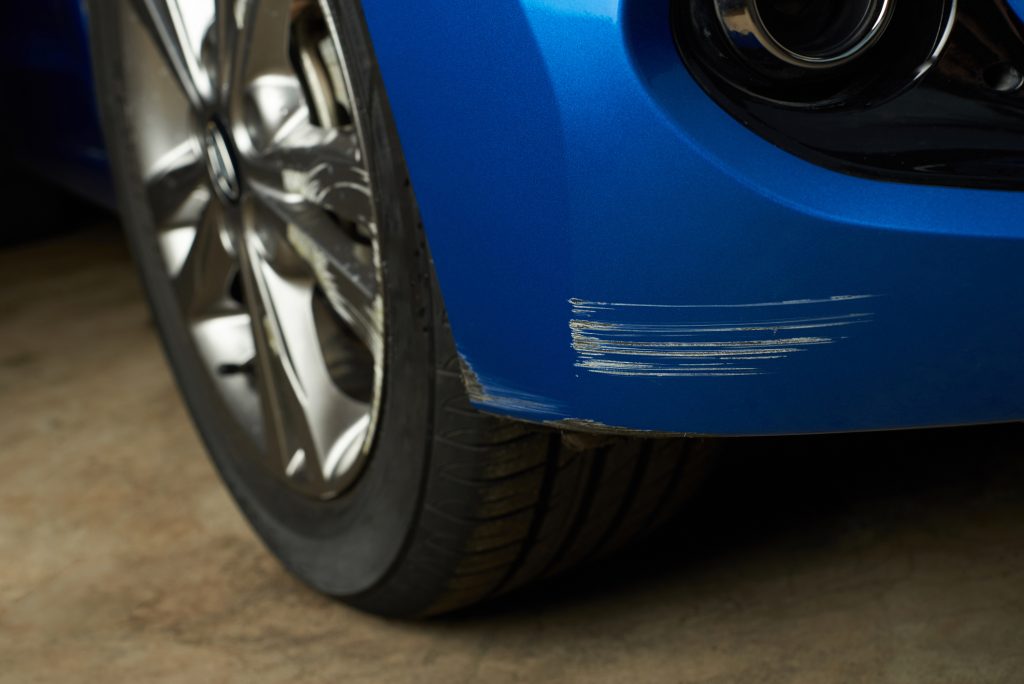
The customer does not distinguish between manufacturing quality and logistics quality. A scratched wheel, dented panel or damaged bumper at delivery is simply a quality problem associated with the vehicle—and therefore with the brand.
Finished vehicle logistics consequently becomes part of the market-entry proposition.
The handover is becoming one of the most important moments in the journey
Traditionally, vehicle condition inspections have depended heavily on people.
An inspector walks around the vehicle, identifies visible damage, records it and creates evidence of the vehicle’s condition.
Human expertise will continue to matter, but technology is changing what is possible.
Fixed scanning systems, drive-through inspection portals, mobile imaging devices and increasingly sophisticated camera systems can now create a much more comprehensive digital record of vehicle condition at critical points in the journey.
That matters because the handover between two parties has historically been one of the most difficult areas of damage management.
If damage is identified several stages later, determining where it occurred can become a lengthy process involving inspection reports, photographs, timestamps, transport documents and competing interpretations of responsibility.
Now imagine instead that every significant custody transition creates a timestamped digital condition record associated with the VIN.
The question changes from:
“Who damaged this vehicle?”
to:
“What changed between inspection point A and inspection point B?”
That is a fundamentally better question.
AI makes the evidence more useful
The significance of scanning technology is not simply that it produces more photographs.
The real opportunity comes when condition data can be analysed automatically.
AI and computer vision can increasingly assist in identifying changes in vehicle condition between different points in the logistics journey.
A vehicle enters a compound with one recorded condition and leaves with another. A vehicle is scanned before loading and again after unloading. A vehicle arrives at a port and its condition can be compared with the record from the previous custody point.
Instead of claims teams manually reconstructing the vehicle journey after a problem has occurred, technology can help narrow the window in which the damage is likely to have happened.
That has obvious implications for claims management.
Better evidence can reduce ambiguity.
Reduced ambiguity can accelerate the identification of probable liability.
And faster identification can reduce the administrative cost associated with disputes.
Technology should not be expected to make contractual or legal liability decisions by itself. But it can make the underlying evidence considerably stronger, faster and easier to interpret.
The bigger opportunity is not claims but risk intelligence
There is, however, a danger that the industry sees scanning and AI primarily as tools for determining who should pay for damage.
That would miss the larger opportunity.
The most valuable damage claim is ultimately the one that never needs to be made.
If condition information from thousands—or eventually millions—of vehicle movements can be brought together with operational data, the industry can begin to identify patterns.
Perhaps a particular route generates an unusually high incidence of wheel damage.
Perhaps damage increases at a particular compound during periods of high throughput.
Perhaps a specific loading configuration correlates with underbody damage.
Perhaps one rail terminal, port operation, vessel route or transporter combination produces a statistically unusual damage profile.
Perhaps certain vehicle dimensions or designs create increased exposure at particular stages of the logistics process.
Individually, these incidents can look like unrelated claims.
Collectively, they become risk intelligence.
From damage reporting to damage prediction
This is where the next stage of finished vehicle quality management becomes particularly interesting.
Real-time operational data, condition scanning and AI potentially allow the industry to move through three distinct stages.
First, record what happened.
Second, identify where and why it happened.
Ultimately, predict where it is most likely to happen next.
That third stage changes the role of damage management.
Instead of a vehicle quality team primarily reviewing incidents after the event, it could increasingly identify elevated risk within live vehicle flows.
That is the difference between administering damage and managing quality risk.
A global problem needs a common quality language
The automotive industry will continue to operate through different regional logistics models.
There is no reason to expect those differences to disappear.
But beneath them sits a process that is surprisingly universal and that consistency creates an important opportunity for the global automotive industry.
If we can establish reliable condition data at the points where vehicles change hands, connect that information across the journey and use AI to identify patterns within it, damage management can evolve from a largely reactive process into a proactive quality discipline.
The industry will always need to establish responsibility when damage occurs.
The more important question for the future is whether we can use the same evidence to make sure it occurs less often.
That may ultimately be the biggest contribution technology makes to finished vehicle logistics: not helping us process damage faster but helping us prevent it in the first place.
